
We’ve just returned from our first Shopify Editions.dev event, and it was a blast. The .dev event quickly followed the Summer ’25 Shopify Editions – an announcement of all the latest releases from the Shopify Product team.
While this event was geared towards the builders, and there were many app developers in the room, the talks were split into two tracks: Dev Mode and Biz Mode.

Let’s run through some of our highlights and consider what they mean for the ecosystem & ecommerce going forward.
We started the day with an on-stage rundown of some of the highlights from the Horizon editions release.
Horizon & Themes: A New Starting Point
Starting with the Edition’s namesake, the Horizon themes. These are a new set of foundational themes from Shopify. They can be thought of as opinionated starting points.
It was implied that the Horizon themes are a re-envisioning of the Dawn theme. Rather than backporting support for newer Shopify features like theme blocks, they instead took the opportunity to create what they think is the best example of a Shopify theme as it stands today.
It does leave some confusion within the theme ecosystem, as while it appears that Horizon is positioned to replace Dawn, Dawn hasn’t been officially deprecated yet, and there is some development tooling in Dawn that isn’t yet in Horizon.
AI in the Storefront: From Blocks to Agents
Imagine having v0.dev within the Shopify theme editor. When the available app and theme sections don’t meet the levels of your creativity, you can simply describe the type of component to Sidekick and the AI-powered theme block generator will craft the required HTML, CSS, JS and even some suggested section settings. We were demoed an example of generating a product cart block where each card was floating and could be dragged around. It was complete with settings to select the products to display and style choices for the cards.
This, in combination with support for nested sections, gives content managers a lot more freedom to update content without the delay of coordinating & scheduling with a development team.
The interweaving of AI continued with the release of the storefront and customer account MCP. This means that you can build an agent and then easily provide it with tools to fetch product information, create and manage a cart and fetch customer order details. The most obvious use case is a chatbot shopping agent.
The New Dev Experience: Tooling & Access
A theme for this edition was developer experience, especially by removing the papercuts.
- They’ve re-engineered app development with a next-generation app development toolkit that is soon to become publicly available.
- Shopify CLI now supports localhost development, reducing the time lost to tunnel setup and environment delays.
- They’ve provided a development MCP server with tools like searching Shopify dev docs and inspecting GraphQL schemas. This means any code that your AI agents implement is more likely to be correct.
- Developers can now choose what Shopify plan dev stores are on so that it’s easier to test functionality against all plan levels, including Plus.
- Unified Polaris – Previously, there were different versions of the Polaris UI library for admin, checkout and customer accounts. This caused confusion when naming conventions and how they could be used differed. Shopify have created a consistent experience for developers by adopting web components that can then be used in all areas of the platform.
- Previewed an upcoming feature for apps to register admin intents. A way of surfacing app functions/commands so that they can be triggered anywhere within the admin. Think of it like ⌘K for Shopify.
They’ve also reduced the number of requirements that apps need to meet to be considered Built for Shopify. It appears that this has been achieved by making the requirements less specific, e.g. “follow UX best practices”. This gives app developers more room to manoeuvre when it comes to building apps, but perhaps also less transparency when it comes to the Shopify review.
Lastly, Shopify demoed an impressive new command-line tool for exporting and importing your Shopify store data. This lays the foundation for first-class staging-to-production pipelines with synchronised store data, which would be very powerful and valuable to larger businesses. It exports data to an SQLite database, which is a particularly novel approach. We know how vital data migration is from our work on Hypa Shift, our import/export tool for BigCommerce.
Shopify Catalog: A Platform Shift
One of the most significant platform announcements for the future of the platform is Shopify Catalog. This is an API to be able to search for products across the whole Shopify customer base, and will also come with a global cart (+ presumably ordering process). This has been developed for the likes of Perplexity and OpenAI but will be available to others in time.
This brings Shopify a step closer to becoming Amazon, where all products on the platform form part of a marketplace. It’s long been questioned why the Shop app hasn’t become that marketplace. Perhaps the reason is that Shopify has the fundamental belief of raising up the brands, and not itself, when it comes to the consumer experience. This change ensures Shopify continues to be the facilitator.
From a technical perspective, it’s certainly a statement to be able to have all products on the platform available in a single searchable API. Though they unfortunately didn’t provide any figures on how many products this would be. A benefit of such an API is to be able to provide live catalog data and remove the need for product feeds to be synced to third-party systems. Imagine not having to index the internet of ecommerce things, because Shopify just provided an API to it.
We’re all left wondering what this will mean. It’s clear that this is for AI agents right now; it’s not just a technical experiment. But where it goes from there, we’re unclear, and Tobi himself admitted he doesn’t know either. Once again, Shopify isn’t just building features, it’s building the primitives that future ecommerce will be built on.
Some questions that were left unanswered include:
- How does a brand optimise its store for search within Shopify Catalog?
- How does a brand control its listings, particularly across markets

Tobi on AI, Mistakes & Building for 100 Years
We were privileged to hear Tobi answer some audience questions, ranging from reflecting on Shopify’s mistakes through to how to stay relevant in today’s rapidly evolving world of AI.
Shopify’s goal is to be a 100-year company, and to do that, Tobi has a few guiding principles that he shared.
Firstly, you have to fall in love with the problem, not the solution. The inference being that otherwise, you’ll hold on to the solution for too long, as well as get lost in what you could do, not what was useful to do. This was spoken in direct response to a question of whether SaaS is obsolete. While nuance isn’t conducive to viral sound bites, the answer was firmly no, but you can’t rest on your laurels.
He readily shared that Shopify had made mistakes. One of them was sticking with Elasticsearch for too long – there were fundamental limits that they were never going to be able to optimise their way past. And so now they’ve gone back and are implementing their search technology in C++ that will work at the scale that they need.
Secondly, work from first principles wherever possible. Otherwise, you risk optimising for local maxima. All that following everyone else will do is ensure a regression to the mean. Innovation often requires fundamentally different approaches to solving problems.
Thirdly, building generic software is orders of magnitude more difficult than building bespoke software. The best solutions are the ones where the “primitives” are right. Software built on the right primitives can achieve a lot through the primitive combination rather than a spaghetti mess of feature-specific implementations, especially when you want features across the platform to be compatible.
One of the benefits of in-person events, particularly Q&As, is that the answers are often less polished, more frank than what you’d see online. You get to hear the train of thought, which gives you more insight into how Tobi thinks, and therefore how Shopify thinks.
One thing that comes across is that Tobi is incredibly authentic. He’s not trying to live up to some image of a CEO, or cover over the cracks and present Shopify as better than they are.
Everyone wanted to hear about AI
Unsurprisingly, AI was everywhere at the event. From flagship product updates with AI-generated theme blocks and a revolutionised Sidekick, to the LLMs for building apps roundtable. The only downside is that, like context windows, the rooms were just not big enough! Many missed out as the demand for AI knowledge outstripped room capacities.
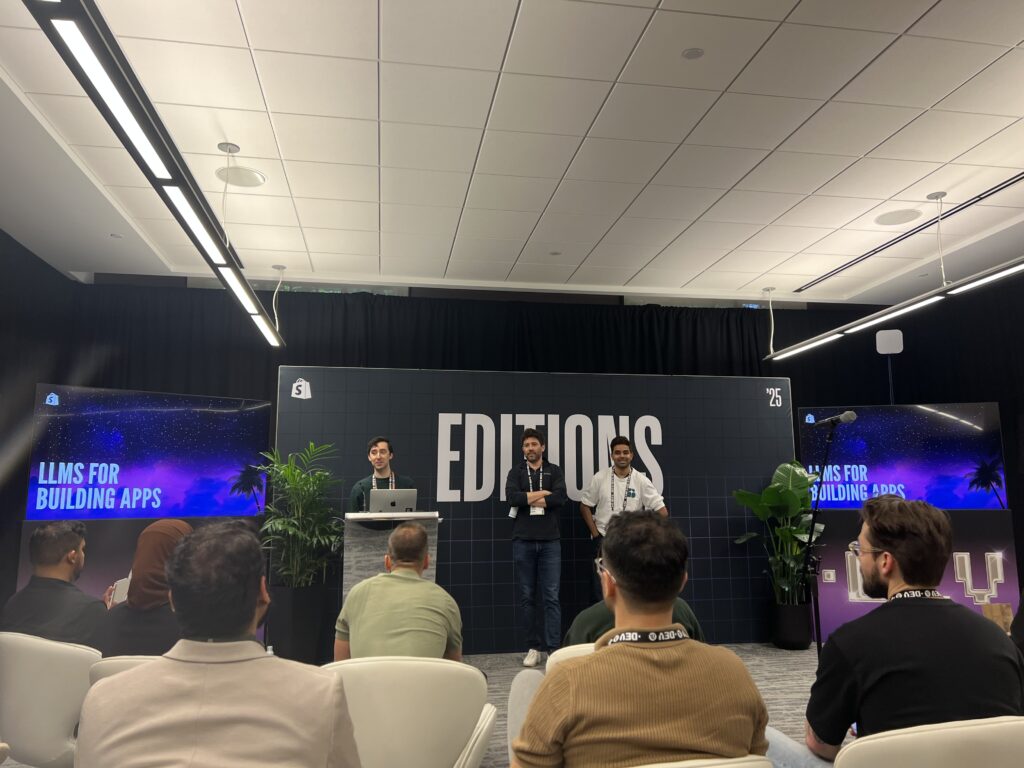
The real barrier to AI adoption isn’t technical, it’s cultural. Teams that adapt their workflows and embrace tools like Claude, Cursor, and MCP quickly see the upside. You don’t have to have AI experts or sophisticated model training.
For many of us, being on the forefront is about:
- Providing access to coding agents through Cursor or Claude Code, and then empowering them with MCP tools.
- Refining the experience with good system prompts
- Using tools like Lovable, Bolt, v0.dev for quick prototyping, generating new product designs, etc.
I’ve seen frontend described as a solved problem when it comes to AI code generation. The results are incredibly impressive, especially when you consider the theme block generation example from earlier. However, there’s still some nuance to it, and solutions and workflows aren’t widespread right now. For example, it’s not clear that the theme block generator currently uses the theme’s design tokens, and so it’s not going to automatically look like the rest of the site. Similarly, while there are efforts ongoing in this area, there’s no clear workflow for theme builders to take a design and create a Shopify theme just yet – but it’s clear that’s the direction that we’re going in.
So, is that it, no more need for theme developers? I don’t think so. It helps retailers move faster and create new content blocks without developers, but I think just as much does this empowers developers to achieve more, too.
One thought shared is that as AI lowers the cost of implementation, the importance of design as a differentiator increases.
Awards & Community Highlights
The day’s programming was brought to a close with the Shopify Build awards presented by Harley Finklestein and Liam Griffin. Here they celebrated the best apps, storefronts and community members.
For apps, the awards went to
For storefronts, the awards went to:
Finally, special recognition was given to the work that the following people do in the community:
Culture & Independence: What Makes Shopify Different
We’ve been to many ecommerce conferences over the years, but Shopify is not afraid to break from traditions. Their culture empowers those who think independently, from first principles. They’re never afraid to be themselves, run events the way that they want to, thinking from first principles, and not falling into the trap of following the crowd.
Beyond the build awards, where app & theme developers were celebrated, there was very little mention of partners. In the BigCommerce and Magento world, events were often presented alongside partners. Partly this is likely due to the lack of need for financial aid, but it was somewhat at odds with the messaging of being lifted by the community. Even in the AI apps discussion, there was little mention of Gadget.dev, a popular Shopify app builder tool that recently landed the number one spot on Product Hunt.
Final Thoughts: Where Shopify Is Headed Next
Shopify is the most popular ecommerce platform on the market, and it shows no signs of slowing down. If anything, with their significant cultural shift towards AI, they’re gearing up to deliver value faster than ever before.
Their relentless focus on democratising access to ecommerce technology and providing the plumbing to the future of ecommerce around the planet means that they’re going to be a leader in our industry for decades to come.
As app developers, we’re excited to take advantage of this future. Watch this space.
